Welcome to Guilin HCM Machinery Official WebSite!
Welcome to Guilin HCM Machinery Official WebSite!

Release date: 2026-11-02 16:09:51
A calcium carbonate processing plant is more than a grinding machine. It is an integrated production system in which raw material preparation, feeding, grinding, classification, powder collection and finished product handling must work together.
At Guilin Hongcheng (HCM), we focus on the processing of ground calcium carbonate (GCC), which is produced by mechanically grinding calcium carbonate-rich materials such as calcite, marble and shells. The plant configuration depends on the characteristics of the raw material, the required product fineness and the intended production scale.
In this article, we explain the main stages of a GCC processing plant and how we consider the equipment configuration for different production requirements.
Raw material preparation is the first stage of a calcium carbonate processing plant. The size and condition of the feed material directly affect the subsequent feeding and grinding operations.
Calcite and marble are commonly supplied in large blocks. These materials need to be crushed before entering the grinding system. According to the processing requirements described in our calcium carbonate application information, the feed size entering the mill should generally be within 2 cm. For ultrafine powder production, the feed size should be within 1 cm.
The crushing stage therefore needs to be matched to the requirements of the selected grinding equipment. Appropriate preparation helps provide a more consistent feed for the grinding system.
After crushing, the prepared material is transferred to the grinding system through feeding and conveying equipment.
Stable and uniform feeding is important because fluctuations in feed quantity can affect the operating conditions of the mill and the consistency of the production process. The feeding arrangement should therefore be considered together with the crushing capacity and the requirements of the selected mill.
When designing a processing line, we consider how the material moves from the raw material storage area to the grinding equipment, rather than selecting the mill as an isolated machine.
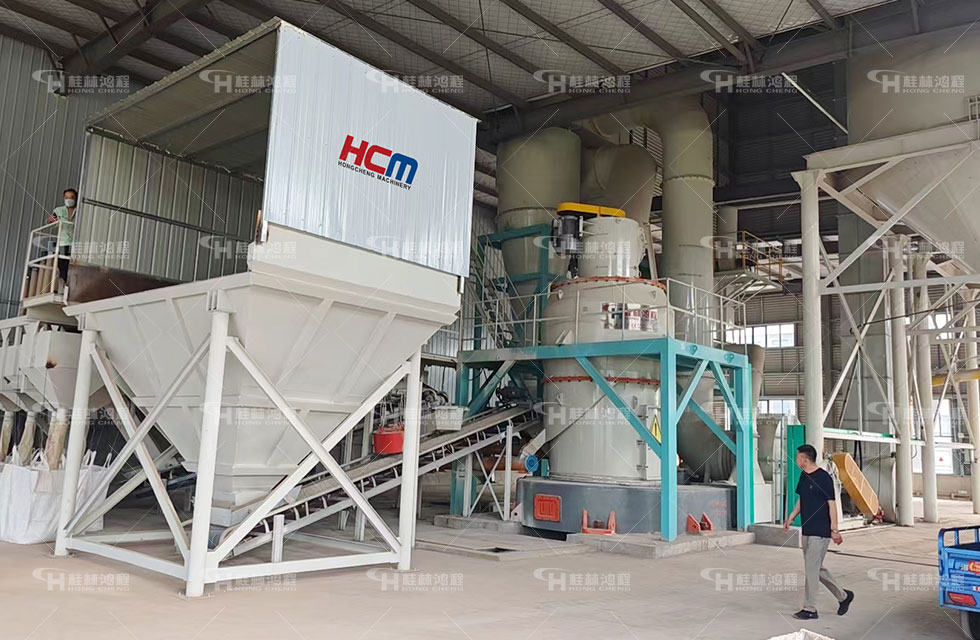
Grinding reduces the prepared calcium carbonate material to the required powder size. It is one of the main stages in the plant and has a direct influence on the final product.
At HCM, we provide different grinding equipment series for calcium carbonate processing, including:
HLM vertical roller mill: For calcium carbonate grinding applications requiring a vertical grinding system.
HLMX ultrafine vertical mill: For high-end ultrafine calcium carbonate processing.
HCH ultrafine ring roller mill: An option for ultrafine powder processing.
HC pendulum grinding mill: For calcium carbonate grinding applications using pendulum mill technology.
These equipment series serve different processing requirements. The appropriate choice depends on the required fineness, feed characteristics, production requirements and overall plant configuration.
A grinding mill should not be selected solely by its model name. We evaluate the material and the target product specifications before determining which equipment is suitable for a particular project.
After grinding, the powder is carried by airflow to the classification system. The classifier separates particles according to the required fineness.
Qualified powder passes through the classifier and proceeds to the collection stage. Material that does not meet the required fineness returns to the grinding area for further processing.
This separation process helps control the particle size of the finished product. For ultrafine calcium carbonate products requiring fineness above 1500 mesh, our official application information recommends secondary classification.
The classification arrangement should be coordinated with the grinding equipment and the target product specifications. It is an essential part of the processing system, not simply an auxiliary component.
After classification, qualified powder enters the collection system for solid-gas separation. Depending on the process configuration, collection can be carried out using a pulse dust collector or a cyclone collector.
The collected powder is discharged through a valve and transferred to the next handling stage. In an airflow grinding system, most of the air can be recirculated, while excess air passes through pulse dust collection before being discharged.
The collection equipment must be matched to the grinding and classification system. Its configuration affects how finished powder is separated and transferred, as well as how the airflow is handled within the production line.
Once the powder has been collected, the finished product needs to be transferred, stored and prepared for delivery.
Depending on the plant layout and the customer's requirements, the collected calcium carbonate powder can be conveyed to a finished product silo or discharged into a bulk tanker through a bulk loading machine.
These arrangements connect the powder processing stages with downstream storage and shipping operations. When planning a complete GCC production plant, we consider the finished product handling system together with the grinding and collection equipment.
There is no single equipment configuration suitable for every calcium carbonate processing project. Different raw materials, product specifications and production requirements can lead to different plant layouts.
At HCM, we consider several key factors when developing a processing solution:
Raw material characteristics: The type, feed size and condition of the calcium carbonate-rich material.
Required product fineness: The target particle size and whether ultrafine processing or secondary classification is required.
Production requirements: The required output and the operating conditions of the production line.
Process configuration: The coordination of crushing, feeding, grinding, classification, collection and conveying equipment.
Finished product handling: The requirements for powder storage, conveying and bulk loading.
Our product range includes HLM, HLMX, HCH and HC grinding mill series for different calcium carbonate processing applications. We select and coordinate equipment according to the actual requirements of each project, rather than applying the same configuration to every plant.
A calcium carbonate processing plant is an integrated system covering raw material preparation, feeding, grinding, classification, powder collection and finished product handling. Each stage needs to be coordinated to meet the requirements of the final GCC product.
At Guilin Hongcheng, we provide grinding equipment and processing solutions for ground calcium carbonate production. By evaluating the raw material, target fineness and production requirements, we help determine a suitable combination of grinding and auxiliary equipment for each processing line.
